
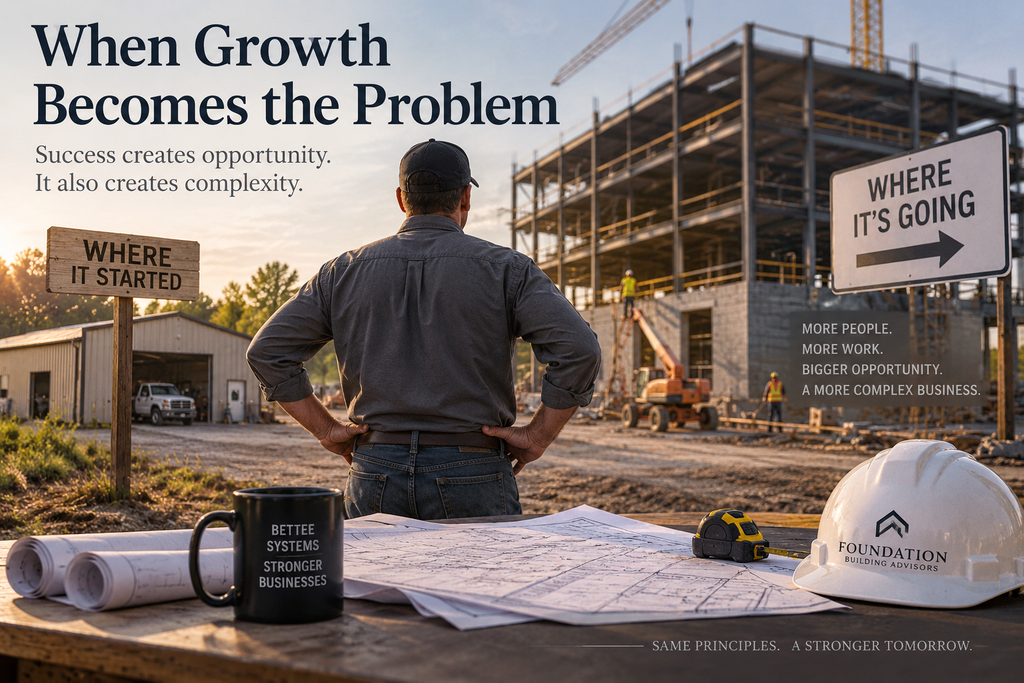
Growth is usually treated as proof that a business is succeeding.
More customers. More employees. More equipment. More revenue. A larger building. Another crew. Another location.
From the outside, these are signs that things are going well.
And they can be.
But there comes a point in the life of many businesses when growth stops solving problems and begins exposing them.
The systems that helped build the company may no longer be capable of supporting the company it has become.
In the beginning, an owner can know almost everything happening inside the business. They know which jobs are coming up, which customers need attention, what materials have been ordered, which employee can handle a difficult assignment and where the money is going.
Problems are solved through experience and communication.
Someone asks a question.
The owner answers it.
Something changes.
Everyone adjusts.
For a small organization, that can be remarkably effective.
It may even be one of the reasons the company succeeds.
Then the business grows.
Five employees become fifteen.
One crew becomes three.
A few projects become a backlog.
The owner who once knew the status of every job now has supervisors, managers, schedules, vendors, customers and employees competing for the same attention.
Information that once traveled through conversation now has to travel through a system.
Decisions that once required one person now cross several responsibilities.
Small inefficiencies begin multiplying.
A material delay affects a crew.
The crew delay affects the schedule.
The schedule change affects another project.
The project manager calls the owner.
The customer calls the office.
Someone works overtime to recover the schedule.
The job eventually gets completed.
From the outside, the system appears to have worked.
But did it?
The business may have completed the job because experienced people worked around the system rather than because the system worked.
That distinction becomes increasingly important as a company grows.
Eventually, the symptoms begin appearing.
Employees seem busier, but productivity does not increase proportionally.
Managers spend more time solving immediate problems.
Overtime increases.
Customers wait longer.
Communication becomes harder.
Margins begin tightening even while revenue increases.
The owner hires people but somehow remains involved in everything.
The natural conclusion is often:
We need more people.
Sometimes that is exactly right.
But sometimes it isn’t.
Before adding another employee, another crew, another manager or another piece of equipment, there is a different question worth asking:
Is the business actually short on capacity, or has it outgrown the system being used to manage the capacity it already has?
Those are very different problems.
If ten employees are losing hours every week waiting for information, materials, approvals or decisions, hiring two more employees may increase payroll without correcting the reason productive time is being lost.
If managers spend their days answering questions that should already have clear answers, adding another manager may simply create another person participating in the same inefficient process.
If the owner remains the final decision point for dozens of routine decisions, adding another crew may actually increase the owner’s workload instead of reducing it.
Growth magnifies whatever already exists.
Strong systems become more valuable.
Weak systems become more expensive.
Informal processes that were harmless at a smaller scale can become serious constraints when repeated across dozens of employees, hundreds of customers or millions of dollars in revenue.
That does not mean the business was poorly built.
Quite the opposite.
The original system may have been exactly what the business needed to reach its current size.
But the system that gets a company from the beginning to its first million dollars may not be the system capable of taking it through the next five million.
Eventually, the business has to evolve.
Knowledge has to move from people’s heads into processes.
Responsibilities have to become clearer.
Information has to reach the right people without traveling through the owner every time.
Performance has to become measurable.
Problems have to be examined for their causes rather than repeatedly corrected at the symptom.
And leadership has to gradually move from personally controlling every outcome to building a system capable of producing those outcomes consistently.
That transition is difficult because it often happens while the business appears successful.
There may be plenty of work.
Revenue may be increasing.
Employees may be busy.
Customers may still be calling.
Nothing appears broken enough to demand immediate change.
Until suddenly it does.
Growth itself was never the problem.
The problem was expecting the systems built for yesterday’s business to continue carrying tomorrow’s.
Growth does not create every weakness in a business. Often, it simply makes the weaknesses that were already there too large to ignore.
— Foundation Building Advisors